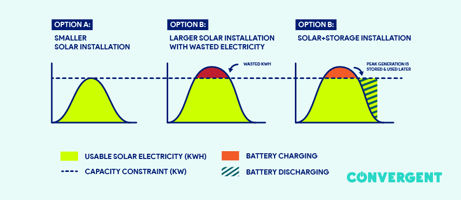
Battery storage systems store energy when it’s not needed for when it is needed most (i.e. the hottest hours of the hottest days of the year). These hours, often referred to as “grid peaks,” are often subject to “time of use” pricing. In other words, electricity is most expensive when it is in greatest demand.
This summer, the case for on-site battery storage is abundantly clear:
🔥 Heat Wave Scale
- More than 200 million Americans were affected by dangerous heat during the late June–early July heat dome spanning the Central and Eastern U.S.
- More than 1,500 daily temperature records were broken during the first half of July across the U.S.
- Many regions experienced temperatures 10–15°F above normal for multiple consecutive days.
⚡ Electric Grid Records
ERCOT (Texas)
- 91.3 GW of electricity demand—the highest demand ever recorded on the Texas grid.
- The new peak surpassed the previous record by nearly 4 GW in just a few days.
PJM (Mid-Atlantic/Midwest)
- Peak demand climbed to roughly 163 GW during the July heat wave, approaching the all-time record.
- Federal emergency measures were authorized to help preserve reliability as demand approached historic levels.
🔋 Why On-Site Battery Storage is Beneficial in a Heat Wave
1. Reduces peak demand on an overstressed grid
Recent heat waves across the U.S. provided a real-world demonstration of how on-site and behind-the-meter battery energy storage systems (BESS) can support both the electric grid and industrial facilities simultaneously.
During extreme heat, electricity demand spikes in the late afternoon as air conditioning load peaks. Batteries discharged during these hours, reducing the amount of electricity customers needed to draw from the grid.
For industrial and commercial facilities, this meant:
- Shaving peak demand charges
- Lowering the facility's grid consumption during critical hours
- Reducing stress on local distribution infrastructure
For example, during the July 2026 Texas heat wave, ERCOT reached a record demand of more than 91 GW. Texas now has roughly 21 GW of installed battery storage, the largest fleet in the U.S., helping maintain reliability despite record electricity consumption. During that heatwave, battery storage reached a record discharge of approximately 11.7 GW.
2. Provides capacity when the grid needed it most
Unlike traditional generators that require startup time, batteries respond in milliseconds. During heat waves battery storage systems can:
- Inject power immediately as demand spikes
- Reduce reliance on expensive peaking generators
- Help maintain operating reserves
- Improve system reliability during the most critical hours
Battery storage systems fast response is particularly valuable because demand ramps quickly between roughly 4 p.m. and 8 p.m., when air conditioning remains high but solar production begins to decline.
3. Allows industrial facilities to remain operating at full capacity
Many manufacturers, logistics facilities, food processors, and data centers cannot tolerate even brief interruptions. On-site battery storage systems can help these facilities during a heatwave, or any grid peak, by:
- Maintaining operations during short outages
- Supporting critical loads
- Avoiding production losses
- Reducing dependence on diesel backup generators for short-duration events
Facilities could continue operating while also reducing grid demand during peak periods.
4. Helps customers participate in demand response programs
Many commercial battery owners participate in utility or ISO demand response programs.
During recent heat waves, batteries were dispatched to:
- Reduce facility load
- Export power where market rules allow
- Support local feeders experiencing high demand
- Help utilities avoid emergency operating conditions
- This provides a new revenue stream while improving grid reliability.
Key Takeaways on the Value of Battery-Storage to Your Business
- For businesses, strategically and cost-effectively meeting energy needs is critical. This is only getting harder in the face of increasingly frequent and intense weather events.
- Grid challenges are compounded by rising energy costs and demand.
- When demand outpaces supply (usually on hot summer days), prices can soar astronomically. The largest users of electricity (the commercial and industrial sector) are especially vulnerable to rising electricity costs being driven by higher temperatures.
- Battery energy storage offers an innovative solution to reduce exposure to extreme weather events and the correlated, rising price of electricity.
Start Saving. Connect with Convergent.
With electricity costs rising for the foreseeable future as heatwaves and extreme weather become the new normal, now is a critical time to plan ahead.
Convergent has 15 years of experience providing energy storage solutions to businesses like Shell and Ford and over 900,000 battery storage operating hours.