Data Centers Power Constraints and Battery Storage
Many interconnection queues are delayed by the need for new transmission lines, substation upgrades and grid reinforcement studies. In many regions, interconnection can take 5–10 years. A data center shell can be built in 12–24 months. But if power isn’t available, it just sits idle. No power = no servers running = no revenue.
Battery energy storage systems (BESS) are becoming one of the most effective tools for helping data centers accelerate their path to power—often referred to as speed to grid. Rather than waiting years for the utility to build new infrastructure, battery storage systems can help data centers energize sites sooner than they otherwise would be able to by reducing the amount of grid capacity they need from utilities upfront and providing them with flexibility.
This is why many utilities, data centers, and independent power producers are increasingly viewing battery energy storage systems as a critical enabler of AI and data center growth, especially in regions where transmission and substation capacity have become the primary bottlenecks.
How Battery Storage Reduces Data Centers’ Peak Demand
For data centers, battery storage is no longer just a resilience solution—it's becoming an interconnection strategy. By reducing peak demand, enabling phased construction, supporting constrained grids, and providing operational flexibility, on-site batteries can help data center developers:
- Secure utility approval faster
- Energize facilities sooner
- Generate revenue earlier
- Avoid or defer costly infrastructure upgrades
- Improve project economics while supporting grid reliability
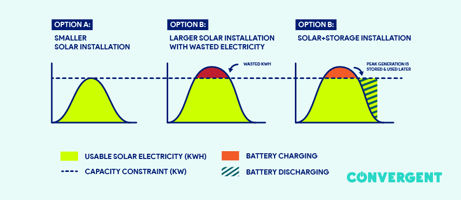
A battery storage system can discharge during those peaks, allowing the data center to:
- Reduce its maximum demand from the grid
- Fit within existing utility capacity
- Avoid waiting for expensive transmission or substation upgrades
For example, a data center may have a center peak load of 100 MW, a continuous load of 75 MW, and pursue a 25 MW / 100 MWh battery storage system. In this case, the data center’s utility only needs to deliver ~75 MW most of the time while the battery supplies the remaining 25 MW during peaks. That difference can mean the difference between energizing in 18-24 months versus waiting 4–7 years for new infrastructure.
With on-site battery storage, data centers can start sooner, smooth demand, and scale up over time. A good analogy here would be to think of the electric grid as a highway with limited lanes.
- Without batteries → data centers need to wait for the highway to be widened.
- With batteries → data centers can add a “buffer lane” so traffic can flow now, even if the highway isn’t fully expanded yet.
Why Utilities Like This Approach
The anticipated surge in demand from data centers—amongst other sources of growth like electrification and reshoring of manufacturing—is driving load growth figures that have no precedent in the last three decades (at least!). The load growth the U.S. is experiencing is a huge shift for utilities, and one that is challenging for the traditional utility planning paradigm.
Historically, utility planning, procurement, transmission development, and rate recovery were designed for gradual load growth and long-lived infrastructure decisions utilities plans were built around all built around 0-1% load growth. Data centers bring in uncontrollable, long load and flip utility planning on its head.
As the U.S. facing its first major load growth cycle in decades, ~46% of new data centers require transmission upgrades to reach full capacity. These upgrades take around 4-8 years or more, while data centers need to monetize capacity immediately.
In core hubs like Northern VA, IL, OR, and TX, thousands of interconnection points are constrained, forcing developers into queues or delays. From the utility's perspective, batteries transform a large, inflexible load into a controllable resource.
Instead of seeing a new 100 MW customer, they may see:
- A 75 MW firm load
- 25 MW of dispatchable storage
- A customer willing to curtail during system emergencies
That flexibility can significantly ease interconnection challenges and improve system planning, as battery storage systems can deploy faster than competing technologies while providing the flexibility that utilities and data center developers need.
When Battery Storage Supports Speed-to-Grid Most
While battery storage is a resource for speed-to-grid, it is most valuable under certain circumstances:
- Interconnection delays >3 years
- Partial / constraint grid availability
- Market with flexible load frameworks
- High-value compute for data centers
Convergent Energy and Power: Proven Battery Storage Expertise
The bottom line: battery storage offers the best chance to meet the data center opportunity—and demand—for accelerating path-to-power.
Waiting too long to develop a co-located battery storage system can mean even longer interconnection timelines, higher costs, and reduced flexibility to meet compliance requirements. Data centers that act now will be positioned to lock in savings before battery prices rise as a result of FEOC, ensure operational readiness, and avoid getting caught in the next wave of grid congestion.
For 15 years, Convergent Energy and Power (Convergent) has gained deep expertise by working closely with industrial businesses to take the hassle out of on-site renewable solutions by building, owning, and operating systems on our customers’ behalf.