Illinois Senate Bill 25 (SB0025), signed into law in January 2026 as the Clean and Reliable Grid Affordability Act (CRGA), is a comprehensive energy reform package designed to reduce consumer costs, strengthen the power grid, and lift the state's ban on new large-scale nuclear power plants. It authorizes 3 gigawatts of utility-scale battery storage and promotes thermal energy networks.
Most relevant to us and core to the bill itself, are incentives for battery storage, designed to counteract the anticipated energy shortfalls projected by state agencies last month.
The idea—for businesses like yours—is that the energy stored in battery storage systems can be dispatched to the electrical grid when the state’s primary electric delivery companies, like ComEd and Ameren Illinois, face high supply prices during peak hours of use, especially during the summer, also known as “peak shaving.”
Peak shaving can dramatically reduce businesses' capacity and transmission costs—which will continue to rise. Plus, the bill offers an upfront rebate of $250/kWh for energy storage because Illinois wants businesses like yours to benefit from storage. In other words, on-site battery storage in Illinois is a slam dunk for energy-intensive businesses like yours.
In this blog, we’ll cover why now is the time to take advantage of taxpayer dollars and the CRGA to lower your bills and insulate your business.
“Peak Shaving” Explained: How Energy Storage Lowers Capacity and Transmission Charges
Without energy storage (i.e., how the electric grid has been for the past century), electricity must be produced and consumed exactly at the same time.
Battery energy storage systems (BESS) are charged and discharged with electricity from the grid. Lithium-ion batteries are the dominant form of energy storage today because they hold a charge longer than other types of batteries, are less expensive, and have a smaller footprint. Batteries do not generate power; batteries store power. As a result, knowing when to charge and discharge a battery storage system is critical. In most cases, this means charging when energy is least expensive and discharging when energy is most expensive. Battery storage is an increasingly popular solution for businesses and utilities looking to reduce their energy costs.
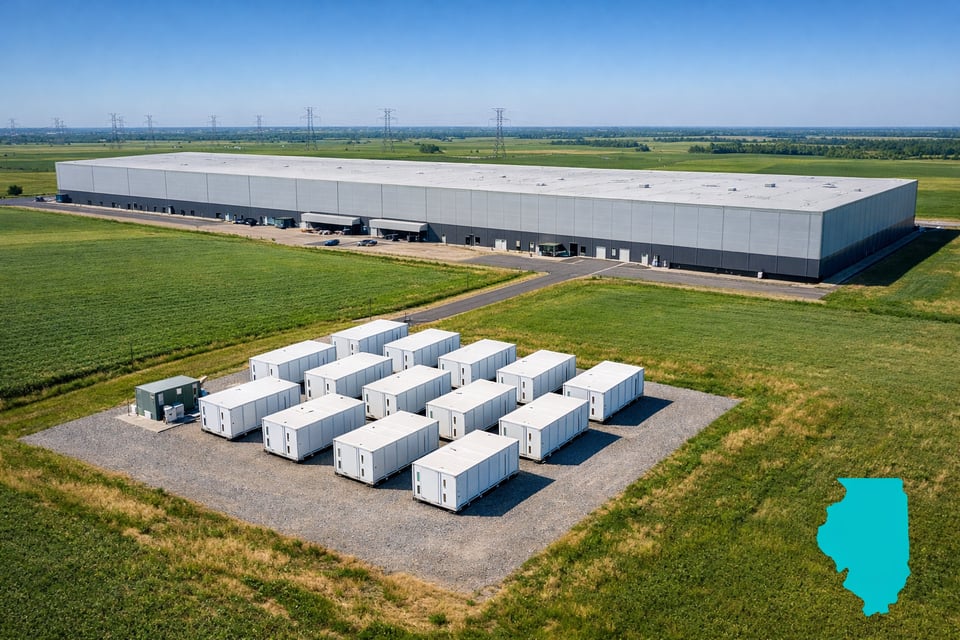
Convergent, a leading provider of energy storage solutions, can forecast electric system peaks and discharge the battery storage system at those times, reducing electricity costs and the need for additional generation. This is also known as “peak hitting” or “peak shaving.”
The ability to charge the battery when energy is least expensive and then consuming the battery’s stored energy when it is most expensive is particularly valuable for businesses like yours in Illinois, which, like the majority of the country, is experiencing both high—and rising—transmission and capacity charges. This is true whether you’re in PJM or MISO, as a customer of either ComEd or Ameren.
Reducing a facility’s consumption during the most expensive hours on the grid can yield seven-figure savings on a facility’s utility bill.
Illinois Electricity Costs and DG Rebate Explained
In addition to using a battery storage system for “peak shaving,” businesses like yours can take advantage of Illinois’ robust Distributed Generation (DG) rebates through ComEd and Ameren. These rebates provide up to $300/kWh for battery storage to qualifying businesses and help offset the cost of energy storage. An upfront check is paid at commercial operation because Illinois wants to incentivize businesses like yours to install battery energy storage systems.
As of October 2025, and the passage of the Omnibus Bill, the DG rebate is now eligible for storage without solar (previously, the rebate required applicants to also have solar PV).

With Convergent, which takes the hassle out of financing, owning, and operating on-site battery storage, the value created is shared.
As is always the case, the rules could change at any time, which is why we are encouraging Illinois businesses to take advantage of these incentives while they’re available.
The bottom line: this is the best, most-incentivized time to apply for the DG Rebate.
How to Get Started on Your Energy Storage System
Convergent, a leading developer of energy storage solutions in North America, has been in the energy storage industry since its infancy, fifteen years ago. Throughout that time, we’ve worked closely with businesses to take the hassle out of energy storage by building, owning, and operating systems on their behalf. We’ve lowered our customers’ energy bills up to 40%. The more you spend on your energy bill, the more you can save with battery storage.
The best part: there’s no capital required from your business. The shared-savings contract Convergent offers means we share in the upside and only make money if our customers do.
Our tagline is “Powered by Results.” We have delivered millions in savings to our industrial customers while enabling them to access more affordable and more reliable power. This opportunity is a win for all involved.
If you’re ready to leverage a battery storage system to lower capacity and transmission costs, and receive the DG rebate with an experienced partner, schedule a free, no-obligation introductory call with our team today.